


 Philipp von der Brüggen
Successful migration to SAP HCM for S/4HANA
With its migration, the goal of municipal utility firm Stadtwerke München was to move from SAP ERP HCM to SAP HCM for S/4HANA (H4S4) without any loss...

Few terms are as overused – as well as misunderstood – as those concerning project management in IT transformations. On PowerPoint slides, it promises order, control, and predictability. In reality, it often means the opposite: a struggle against uncertainty, complexity, and people who are reluctant to change. This blog post looks at why traditional control mechanisms fail when everything is in motion – and what successful project managers actually do differently.
Large-scale IT transformations do not fail because of technology – they fail because of the illusion that they can be managed like construction projects. They are not a sprint, not an agile success story, not a perfectly structured Gantt chart. They are living systems that reshape themselves with every decision made. Yet many managers continue to rely on milestone plans and KPI tracking – only to wonder why progress stalls and costs spiral out of control.
The Natuvion & NTT DATA Business Solutions Transformation Study 2025 demonstrates this clearly: more than 80% of companies exceed time or budget limits; well over half must adjust their methodology during the project; and almost all underestimate the organizational impact of change. The real reason is simple: transformation is not a project. It is a fundamental challenge for any organization accustomed to thinking in silos, deciding in departments, and acting within hierarchies. And precisely for that reason, it requires project management – but in a different form than we are used to. Not as control, but as navigation. Not as reporting, but as a way of demonstrating leadership in the fog.
Large IT transformations are not projects – they are dynamic ecosystems. Yet many organizations still believe they can be planned like construction initiatives: define the budget, set milestones, execute. Reality looks different.
The Natuvion & NTT DATA Business Solutions Transformation Study 2025 shows that more than two-thirds of companies had to implement fundamental plan changes during their transformation – most of them driven not by technical, but by organizational necessity.
The underlying mistake is attempting to combat complexity with control. Successful project managers embrace the opposite: they lead amid uncertainty. They understand that an overly rigid plan can be more dangerous than having no plan at all.
“Faster, more agile, go live earlier!”– hardly any transformation project escapes this mantra. Yet speed is a double-edged sword. According to the study, rushed decisions frequently result in rework and rising costs.
Speed is not an end in itself. It requires organizational absorption capacity: people, processes, and systems must be capable of integrating and processing the new reality. Transformations rarely fail because they move too slowly. They fail because they move faster than the organization is internally prepared to handle.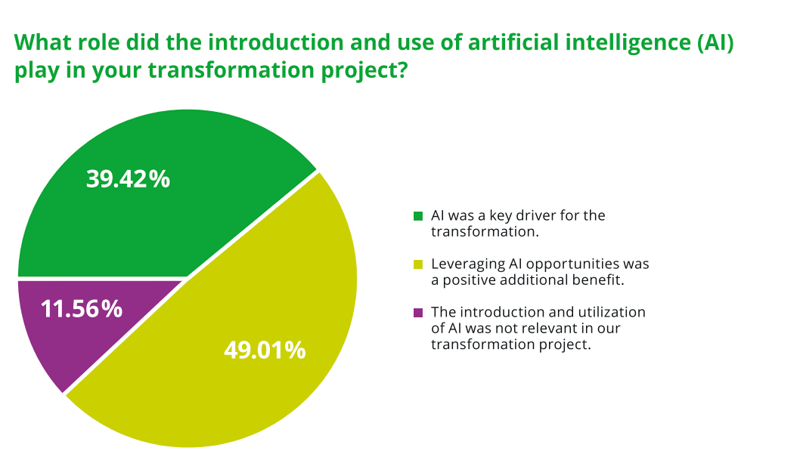
Behind every technical workstream lies a political struggle for influence, budgets, and narrative control. The Transformation Study identifies “stakeholder alignment” as one of the greatest challenges – a term that politely obscures what is actually happening: project management is diplomacy under pressure. Those who merely distribute tasks and measure progress become administrators of chaos. Those who actively moderate tensions, address conflicts, and build shared interests become architects of change. This requires reporting – but even more importantly, it requires relational intelligence.
From a technical perspective, system migration is a solvable challenge. Yet from an organizational perspective, it is often a cultural rupture. When organizations introduce a new ERP system, their decision paths, responsibilities, and sometimes even power structures can change. The study reveals that while change management is recognized as a critical success factor, it is rarely integrated tightly with project management. This is a major mistake. Failing to plan for cultural change means inadvertently programming resistance into the system. Transformation does not mean implementing software – it means renegotiating the identity of a company.
One striking finding of the study was that companies who systematically secure data quality and availability at the project’s outset experience up to 30% fewer delays. And yet in many transformation initiatives, companies treat data management as an afterthought – if they address it at all. Data is the oxygen of any transformation. Without it, processes cannot be automated, insights cannot be generated, and decisions cannot be made.
The blind spot extends even further: according to the Transformation Study, 57% of companies begin their transformation with the goal of leveraging modern technologies such as artificial intelligence, machine learning, or predictive analytics – often without verifying whether their data is ready.
Without clean, consistent, and contextualized data, any AI initiative remains fragmented. Project management that treats data merely as a technical issue overlooks its most powerful lever. In reality, data forms the foundation of digital intelligence – and thus the true starting point of successful transformations.
Perhaps the most uncomfortable truth about large-scale transformations is that no one fully knows what the path will look like – not even project management. Leadership in this context means providing orientation where clarity does not yet exist. It means building trust where control is impossible. The most effective project managers are therefore not taskmasters, but navigators. They combine structure with intuition and experience, methodology with humanity. They understand that transformation is not a checklist – it is a collective learning process.
Project management in major IT transformations is not a battle against chaos; it is the art of dealing with it. Anyone who believes success can be enforced through governance alone underestimates the dynamics of modern organizations. The Natuvion & NTT DATA Business Solutions Transformation Study 2025 makes this clear: transformation succeeds where project management becomes more than administration and evolves into effective change leadership.


With its migration, the goal of municipal utility firm Stadtwerke München was to move from SAP ERP HCM to SAP HCM for S/4HANA (H4S4) without any loss...

When companies transition to SAP S/4HANA, test management - an often-overlooked discipline - determines whether the project runs smoothly or ends in...

As projects grow, so does their complexity. But what if you could describe, understand, and control them in a structured way, like a living system? A...