The question is no longer if, but how and when. How do you approach a transformation to SAP S/4HANA? How do you keep it predictable, efficient, and measurable? Whether you choose greenfield or brownfield, your decision doesn’t change the fundamentals. In every case, data must be analyzed and evaluated, legacy issues identified, and processes reviewed and adapted. What you need is a clear framework, a well-structured roadmap, and expert know-how—from initial planning all the way to go-live.
Greenfield or Brownfield?
The greenfield approach is often underestimated. Many things you assume you no longer need turn out to be necessary after all. This often leads to parallel systems running for years, driving up costs significantly. With brownfield, the opposite tends to happen. Data is carried over into the new system even though it’s no longer needed, unnecessarily burdening the system. That’s why a thorough analysis of the current state is essential before any transformation. Only then can you separate what’s truly important from what’s not. Our SMART methodology is built on five key components that ensure proven processes are retained while also identifying and leveraging optimization potential.
SMART – The five building blocks of transformation
This isn’t just a technical migration—it’s a strategic move with lower risk, faster execution, and clear outcomes.
How the Natuvion Data Conversion Suite (DCS) supports you
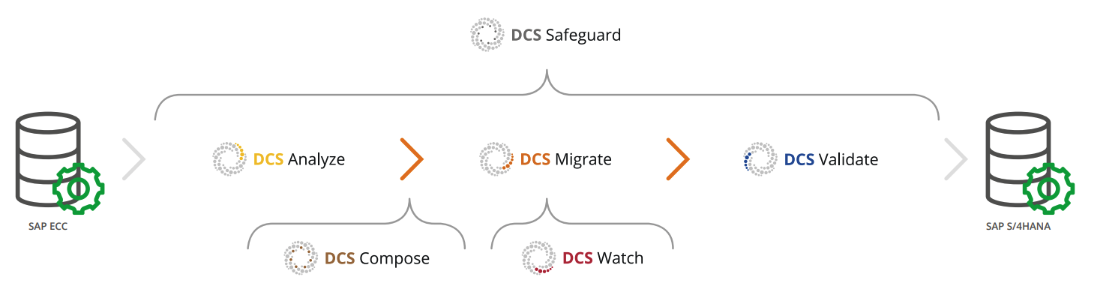
The Natuvion Data Conversion Suite (DCS) is a powerful transformation platform designed to support every phase of your journey. It works by setting up an “empty shell” for the target system and transferring only relevant data. Legacy data remains accessible through DCS Retire in a cost-efficient and GDPR-compliant way. It doesn’t matter which migration approach you choose—project templates can be used for both greenfield and brownfield scenarios, accelerating implementation.
The SMART building blocks in the project lifecycle
Simplify – Scoping with DCS Analyze
Solid preparation is half the battle. DCS Analyze provides full transparency down to table and row level, defines organizational scopes, consolidates existing migration objects into an initial concept, and enhances both the detailed migration plan and the S/4 readiness check.
Master – Data Quality Management (DQM)
DQM reveals the true state of your data quality by filtering out incorrect data and defining concrete improvement measures. Workshops provide business units with detailed process insights and actionable recommendations.
Align – Duplicate Analysis and Harmonization
Duplicate records are unnecessary overhead. They waste time and distort decisions. Duplicate analysis identifies, logs, and consolidates duplicate master data into a single database layer—with rollback options and automated job scheduling for ongoing operations. Harmonization is also ideal as a pre-project, such as when introducing the Business Partner model using Natuvion DCS and CVI.
Reduce – Data Volume Reduction
When moving to a new system, the goals are clear: less data, higher quality, full GDPR compliance, and better performance. This is achieved through SAP archiving and SAP ILM—archiving, deleting, and generating deletion reports.
Transform - System Decommissioning with DCS Retire
A tool that offers you compliant decommissioning of your legacy systems. Legacy data is preserved in its original structure and remains accessible with restricted, role-based permissions. Legal requirements and deletion jobs are automatically scheduled and executed. Data extraction is handled via DCS Migrate.
At a glance: Key facts and your benefits
Key facts
-
Time-critical: ECC support will become more expensive in 2027 and end in 2030.
-
Predictable: clear roadmap with SMART and Natuvion DCS.
-
Efficient: only relevant data is migrated; legacy data is archived in a GDPR-compliant way.
-
Secure: near-zero downtime migration, compliance by design.
-
Sustainable: reduced data volume, higher quality, simplified processes.
Your benefits
-
Faster go-live: standardized templates and proven tools.
-
Lower risk: full transparency, improved data quality, and harmonization.
-
Reduced costs: Lower data volume and fewer rework efforts.
-
Future-ready: clean master data, streamlined processes, and strong governance.